
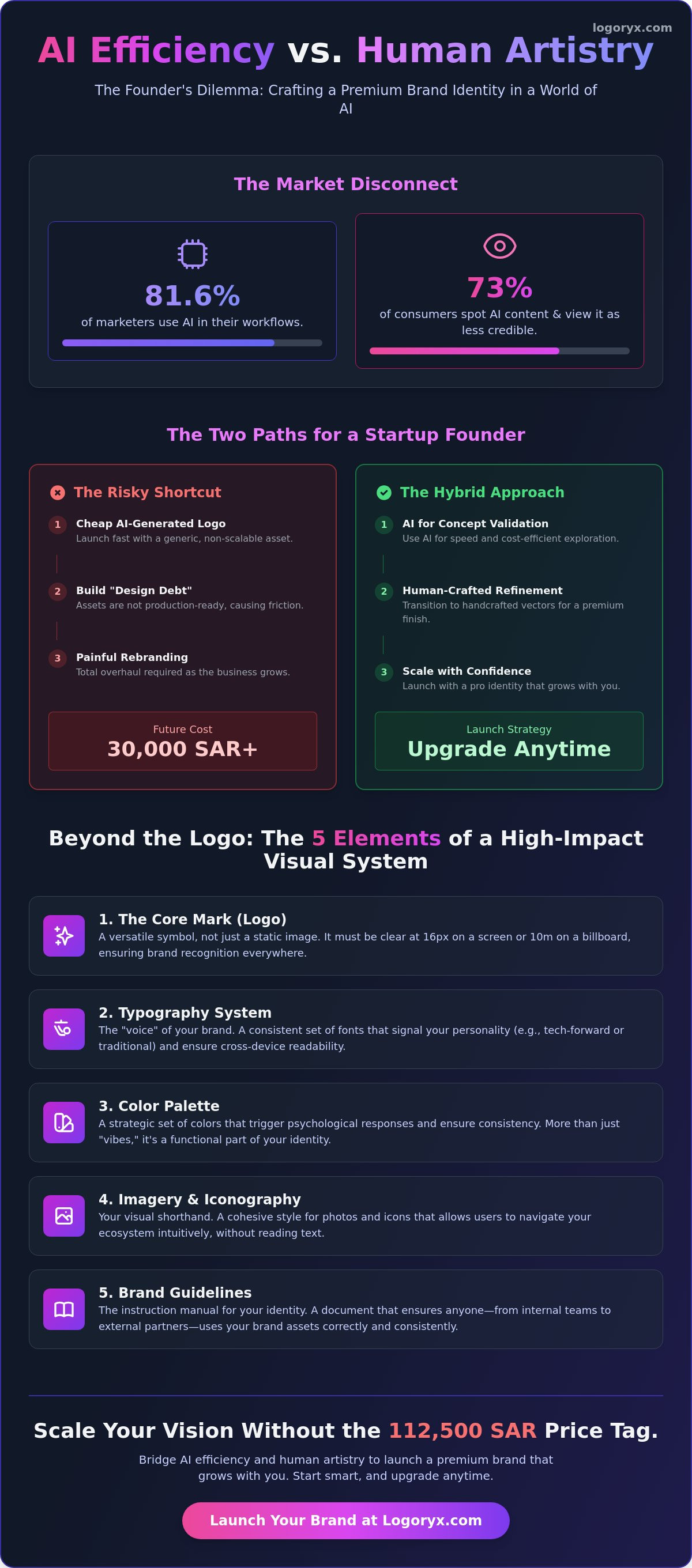
While 81.6% of professional marketers have integrated AI into their workflows as of May 2026, a staggering 73% of consumers say they can spot purely AI-generated content and view it as less credible. This creates a massive dilemma for Saudi founders who need to launch fast but can't afford to look like a generic template. Professional brand identity design is no longer just about a single logo; it's a scalable visual system that must balance technological speed with human craftsmanship to build trust in a competitive market.
You likely feel the pressure to move quickly while fearing that a cheap asset today will cost you 30,000 SAR in rebranding fees tomorrow. It's frustrating to realize that a basic logo isn't enough when you actually need a production-ready system of vectors, typography, and color palettes. This guide will show you how to bridge AI efficiency and human artistry to create a premium brand that scales. We'll explore the technical requirements of SVG assets, the shift toward motion-first branding, and the exact roadmap you need to launch a professional identity without the 112,500 SAR price tag of a boutique studio.
Key Takeaways
- Understand that professional brand identity design is a comprehensive visual system that bridges your product's value with customer trust, far beyond a simple logo mark.
- Learn how to transition from rapid AI-generated concepts to production-ready, handcrafted vector assets that ensure your brand looks premium on any platform.
- Discover the hybrid design path that combines the cost-efficiency of AI for early validation with the artisanal quality of human-crafted refinement.
- Follow a structured roadmap to define your brand DNA and validate visual concepts before investing in a full-scale corporate visual language.
- Adopt an "Upgrade Anytime" strategy to launch your startup quickly while maintaining the flexibility to scale into a custom, high-end identity as your business grows.
Beyond the Logo: What is Brand Identity Design in 2026?
It's tempting to think a logo is the finish line for a new business. In reality, a logo is just a single signature, whereas brand identity design is the entire conversation. In 2026, this process has evolved into a comprehensive visual language that dictates how your business speaks across every touchpoint. It isn't just a mark; it's a living system of colors, typography, and motion rules that ensure your message remains clear whether it's on a smartphone screen or a high-definition billboard.
This system acts as the vital bridge between your product's core value and the trust of your customer. It falls under the broader umbrella of corporate identity, which encompasses the physical and behavioral cues a company sends to the world. When your visual system is solid, it tells the market that your venture is professional, stable, and ready for serious business. Without it, even the best product can feel like a risky bet for a new user.
The landscape in 2026 has shifted toward digital-first identities that prioritize screen legibility above all else. Static branding, where a single file is expected to work everywhere, is dead. Modern founders now utilize dynamic visual systems that adapt across platforms. These systems are designed to be fluid, ensuring that a brand's "soul" stays intact while the assets themselves change shape to fit different technical environments. With 74% of companies globally implementing AI in their marketing as of May 2026, the real differentiator is how you refine these automated concepts into a polished, human-centric system.
Brand Identity vs. Brand Image
Founders often confuse these two terms, but the distinction is critical for your strategy. Identity is the set of tools you create, including your handcrafted vectors and color palettes. Image is the public’s perception of those tools. You don't have direct control over your image, but you have absolute control over your identity. By maintaining a consistent, premium visual system, you close the gap between how you want to be seen and how the public actually perceives you. Consistency is the only way to turn a digital concept into a trusted brand image.
Why Startups Can't Afford to Ignore Identity
Professional design is a functional tool that reduces customer friction during the critical first 24 hours of a user's interaction with your brand. If your assets look amateur or aren't production-ready, you're building "design debt" from day one. Design debt is the cumulative cost of rebranding due to early technical shortcuts. In the Saudi market, where competition for attention is fierce, starting with a non-scalable logo can lead to a total overhaul costing upwards of 30,000 ﷼ later on. It’s much more efficient to start with solid AI concepts and scale into a refined, human-crafted system as you grow.
The 5 Essential Elements of a High-Impact Visual System
A successful brand identity design is not a collection of random files. It is a synchronized engine where five specific components work together to build a premium presence. By May 2026, 84% of senior marketers believe AI gives them a competitive advantage; however, that advantage only holds if these elements are technically sound and production-ready.
The Core Mark is your first element. In the current market, a simple logo isn't enough. You need a versatile brand symbol that retains its clarity at 16 pixels in a mobile app or 10 meters on a Riyadh storefront. Next is Typography. Your fonts must signal authority while ensuring cross-device readability. If you want a unique signature, a custom typography logo provides that handcrafted feel that differentiates you from the 73% of AI-generated brands consumers find generic.
Color palettes in 2026 are no longer just about "vibes." They are about psychological triggers in a digital-first economy. Imagery and iconography serve as your visual shorthand; they allow users to navigate your ecosystem without reading a single word. Finally, Brand Guidelines act as the instruction manual for your brand identity design. This document ensures that whether you're working with an internal team or an external partner, your identity remains consistent.
Typography and the 'Voice' of Your Brand
Your choice of typefaces dictates your brand's personality. Sans-serif fonts often signal innovation and tech-forward thinking. Serifs lean into tradition and trust. For global startups, licensing is a major hurdle. You must ensure your fonts are web-safe and properly licensed to avoid legal friction. If you're unsure where to start, you can generate AI concepts to see which voice resonates with your vision before committing to a full system.
Color Systems Beyond the Primary Palette
A professional system includes primary, secondary, and accent colors specifically mapped for UI/UX. In 2026, following WCAG accessibility standards is a requirement for any brand serious about inclusivity. This means ensuring high contrast for all users. You also need a dedicated dark mode variant from day one. Digital interactions in Saudi Arabia's high-tech landscape often happen on OLED screens. In this context, dark mode isn't just a preference; it's an expectation for visual comfort and energy efficiency.
AI Efficiency vs. Human Artistry: Choosing Your Design Path
The "AI Logo" explosion of 2026 has fundamentally changed how founders approach brand identity design. For early validation, the speed and cost-efficiency of automation are unmatched. You can test a market's reaction to a visual concept in hours rather than weeks. However, relying purely on AI often leads to a lack of technical precision and a missing "soul" that 73% of consumers claim they can identify. The most successful brands in the Saudi market today don't choose between tech and talent; they utilize a "Hybrid Expert" model that bridges the two.
Pure AI outputs are excellent for exploration, but they often struggle with the nuances of high-end aesthetics and cultural context. While an algorithm can follow a prompt, it cannot understand the specific aspirations of a Riyadh-based tech startup or the heritage of a local boutique. You'll know your brand has outgrown a basic AI concept when you reach major milestones, such as securing seed funding or preparing for a large-scale physical launch. At that stage, the "good enough" concept needs to become a production-ready asset that can scale without losing its integrity.
The AI Concept Phase: Rapid Experimentation
In the initial stages of your journey, prompt-based generation allows you to explore dozens of brand directions in minutes. This is the ultimate tool for rapid experimentation. Utilizing an AI logo generator provides a credit-based, low-risk entry point for founders who need to visualize their "Brand DNA" without a massive upfront commitment. It’s a pragmatic way to see what sticks before investing 15,000 ﷼ or more in a comprehensive manual package. This phase is about finding the right spark, not necessarily the final flame.
The Human Refinement Phase: Polishing for Production
Once you have a concept that resonates, human artistry takes over to ensure the design is technically flawless. Professional designers specialize in manual vectorization, creating SVG files that remain crisp at any size. They "fix" the subtle errors in geometry and symmetry that AI often misses, such as uneven line weights or awkward kerning in typography. AI drafts are the "seed" while human designers provide the "soil" for growth. This transition ensures your brand identity design moves from a digital experiment to a premium, solid visual system that is ready for the real agency standard of work.
The Step-by-Step Roadmap to Launching Your Brand Identity
Building a professional brand identity design requires a logical progression from abstract ideas to technical assets. This journey ensures you don't just create a pretty picture, but a functional tool for business growth. By following a structured roadmap, you avoid the design debt we discussed earlier and ensure your brand is ready for the real agency standard of work from day one.
Step 1 begins with defining your Brand DNA. You must pin down your mission, vision, and target audience before touching any design software. Step 2 involves using AI-powered tools to generate and validate concepts. This is your experimental phase where you see which visual directions resonate with your core values. Once you have a winning concept, Step 3 is the critical transition: upgrading to production-ready vector files. This move provides the technical scalability needed for high-resolution applications. In Step 4, you build out the rest of your visual system, including typography, color palettes, and iconography. Finally, Step 5 is consolidation. You must gather these elements into a Brand Style Guide that acts as the single source of truth for your team.
Technical Checklist: What 'Production-Ready' Actually Means
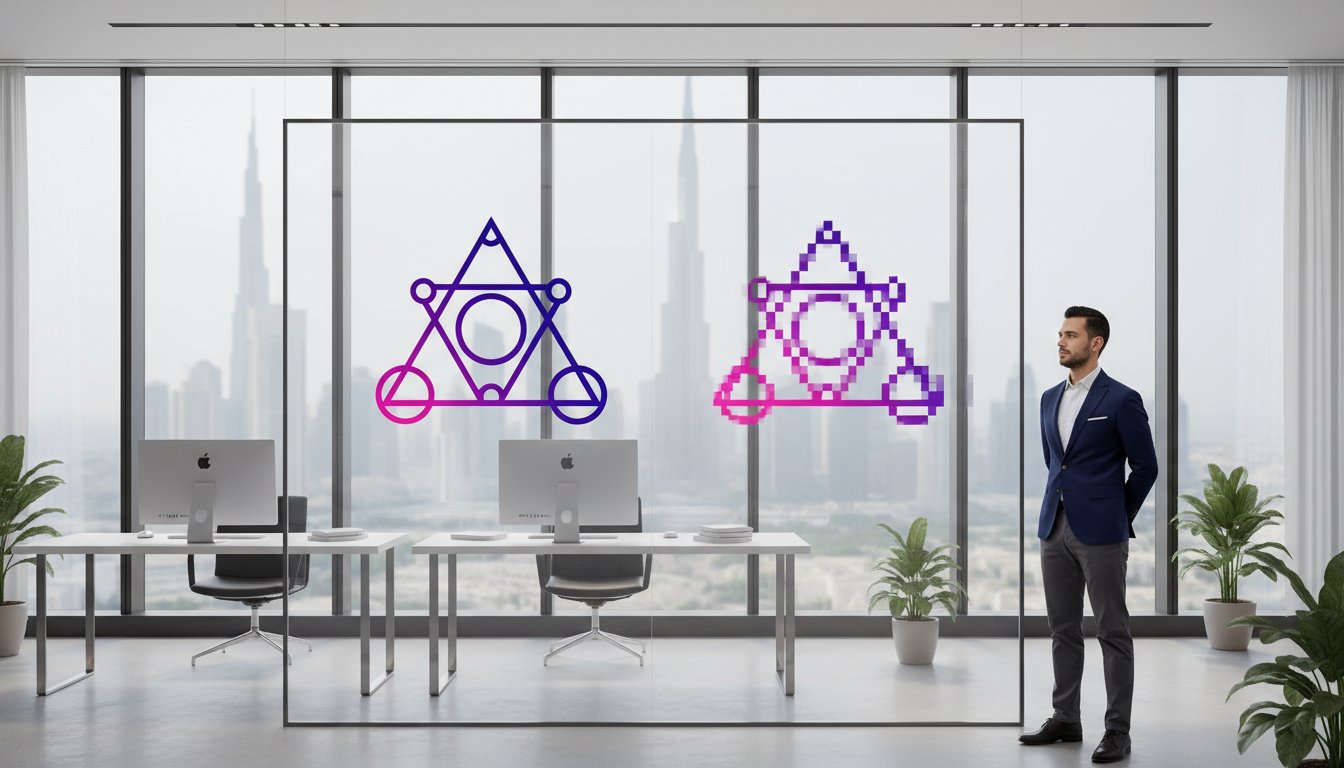
Many founders mistake a high-resolution PNG for a final asset. This is a mistake that leads to pixelated logos on large-scale signage in Riyadh or Jeddah. Raster files like PNGs and JPGs are made of pixels and lose quality when enlarged. Vector files, such as SVG or EPS, are based on mathematical paths; they remain perfectly crisp whether they are on a business card or a massive billboard. Your logo must also pass the "black and white test." If your mark relies on color to be recognizable, it isn't a solid design. A truly premium brand identity design works in its simplest form before any gradients or palettes are applied.
Launching the Identity: Consistency Across Touchpoints
Once your system is built, consistency is your most powerful asset. You need to apply your new identity across social media, pitch decks, and your website immediately. In the fast-paced digital markets of Saudi Arabia, you have roughly two seconds to capture attention in a crowded mobile feed. This "2-second rule" means your brand must be instantly recognizable through its specific color usage and core mark. Your Brand Style Guide is the tool that makes this possible. It allows you to brief future freelancers or agencies with precision, ensuring they don't drift away from your established aesthetic. If you're ready to move beyond basic concepts and build a solid visual system, you can start your brand roadmap today.
Scaling Your Vision: Premium Brand Identity with Logoryx
Logoryx positions itself as the "Hybrid Expert" for founders who refuse to settle for generic templates. While 74% of companies globally are implementing AI in their marketing as of May 2026, the most successful brands understand that automation is the starting line, not the finish. Our platform provides a modular journey that respects the urgency of modern entrepreneurship while delivering the artisanal quality of a high-end agency. This unique approach allows you to secure a professional brand identity design that grows alongside your revenue.
The core of our model is the "Upgrade Anytime" philosophy. You don't need to commit 30,000 ﷼ to a boutique studio before you've validated your business model. You can begin with AI concepts to find your visual spark and then transition to human-crafted refinement when you're ready for a production-ready system. This ensures you never pay for more than you need, yet you're never stuck with a non-scalable asset that creates design debt. For established startups, our Full Brand Identity package serves as the ultimate solution, providing a complete corporate visual language that commands authority in the Saudi market.
The Logoryx Advantage: Speed Meets Craft
Logoryx utilizes a credit-based system that makes brand experimentation entirely risk-free. You can generate dozens of concepts in minutes to explore different visual directions for your Brand DNA. Once you identify a winner, our professional designers take over to provide a manual SVG vector upgrade. These aren't just automated traces; they are handcrafted files polished for technical precision. Whether you're a creator in Riyadh or a small team in the UAE, you receive assets that meet global, premium standards. This ensures your brand is solid and ready for high-resolution print or large-scale digital displays without the technical errors common in pure AI outputs.
Ready to Launch? Your Brand Identity Starts Here
The journey from a digital concept to a premium brand doesn't have to be overwhelming. By following the "Start Small, Scale Fast" roadmap, you can launch with confidence and upgrade as your vision expands. Don't let the fear of complexity or the high entry costs of traditional agencies hold your business back. A professional brand identity design is now accessible, scalable, and tailored to the technical requirements of modern founders. It's time to bridge the gap between AI efficiency and human artistry to create something truly production-ready. Launch your premium brand identity with Logoryx today.
Launch Your Scalable Visual System
The branding landscape of 2026 requires more than a static image; it demands a flexible, high-impact brand identity design that adapts to every screen and surface. A production-ready system reduces long-term costs and builds immediate trust with your audience. By bridging AI-powered speed with human-crafted quality, you can launch your vision without the typical friction of traditional agency timelines.
Logoryx provides the technical foundation you need with handcrafted SVG vector files that ensure your brand stays polished as you scale. Trusted by founders across North America, Europe, and the Middle East, our platform offers a secure and modular journey from initial concept to a premium visual system. Don't let technical shortcuts or high costs stall your momentum. Take the first step toward a professional presence that commands attention in the Saudi market and beyond.
Start building your brand identity with Logoryx
Frequently Asked Questions
What is the difference between a logo and a brand identity?
A logo is a single graphic symbol, while a brand identity design is the entire visual language your business uses to communicate. This system includes your color palette, typography, and specific imagery rules that build customer trust. Think of the logo as the face of the company and the identity as the personality and voice that make the brand recognizable across every digital and physical touchpoint.
Can I use an AI-generated logo for my official business trademark?
You can use an AI concept as a creative starting point, but a unique, human-refined design is usually necessary for a successful trademark application. It's essential to consult with a legal professional regarding Saudi Authority for Intellectual Property (SAIP) requirements. Logoryx focuses on the design process and does not offer trademark registration services; therefore, ensuring your final mark is distinct and legally protectable is a vital separate step.
Why do I need an SVG file for my brand identity?
SVG files are vector-based assets that can scale to any size without losing quality or becoming pixelated. This is essential for professional applications, from tiny mobile icons to massive billboards in Riyadh. Unlike raster PNGs, SVGs allow for technical precision and are the "production-ready" standard for modern design. They ensure your visual system remains crisp and polished across all high-resolution screens and print materials.
How much does a professional brand identity design cost in 2026?
In 2026, freelance brand identity services typically range from 5,625 ﷼ to 30,000 ﷼ for a standard package. Boutique creative studios often require an investment between 18,750 ﷼ and 112,500 ﷼ for a full visual system. Startups at the seed stage should expect to budget between 30,000 ﷼ and 75,000 ﷼ to ensure their assets are high-level and ready for a competitive market launch.
How long does it take to create a full brand visual system?
A full visual system can be established in as little as a few days for AI-powered concepts or up to six weeks for a complete manual agency overhaul. The timeline depends on the complexity of your "Brand DNA" and the level of human refinement required. By using a hybrid model, you can generate initial concepts instantly and then scale to a polished, production-ready system as your business milestones demand.
Can I upgrade my AI logo to a custom design later?
Yes, the "Upgrade Anytime" philosophy allows you to start with an AI concept and transition to a manual SVG upgrade or a full custom design. This modular approach reduces early design debt by letting you validate your business first. You can then invest in artisanal quality once your brand gains market traction. It’s a pragmatic way to move from a digital concept to a premium, solid brand.
What should be included in a startup branding package?
A comprehensive startup package must include a versatile core mark, primary and secondary color palettes, and authority-signaling typography. It also requires a Brand Style Guide and production-ready vector files for scalability. This foundation ensures brand identity design remains consistent whether you are designing a pitch deck for investors or launching a mobile app for your first thousand users in the Saudi market.
How do I ensure my brand identity works on mobile and print?
Ensure your identity works by testing your logo in black and white and at very small scales, such as 16 pixels. A mobile-first design prioritizes legibility on OLED screens, while vector files ensure the same assets look crisp on high-resolution print. This technical versatility is what makes a visual system truly production-ready. It allows your brand to maintain its premium feel regardless of the medium or device.